
CAMP BLANDING – As the base commander of Camp Blanding Joint Training Center, Col. Todd Hopkins realized how few realized what knows what’s beyond the collection of military aircraft and miles of …
This item is available in full to subscribers.
To continue reading, you will need to either log in to your subscriber account, below, or purchase a new subscription.
Please log in to continueDon't have an ID?Print subscribersIf you're a print subscriber, but do not yet have an online account, click here to create one. Non-subscribersClick here to see your options for subscribing. Single day passYou also have the option of purchasing 24 hours of access, for $1.00. Click here to purchase a single day pass. |
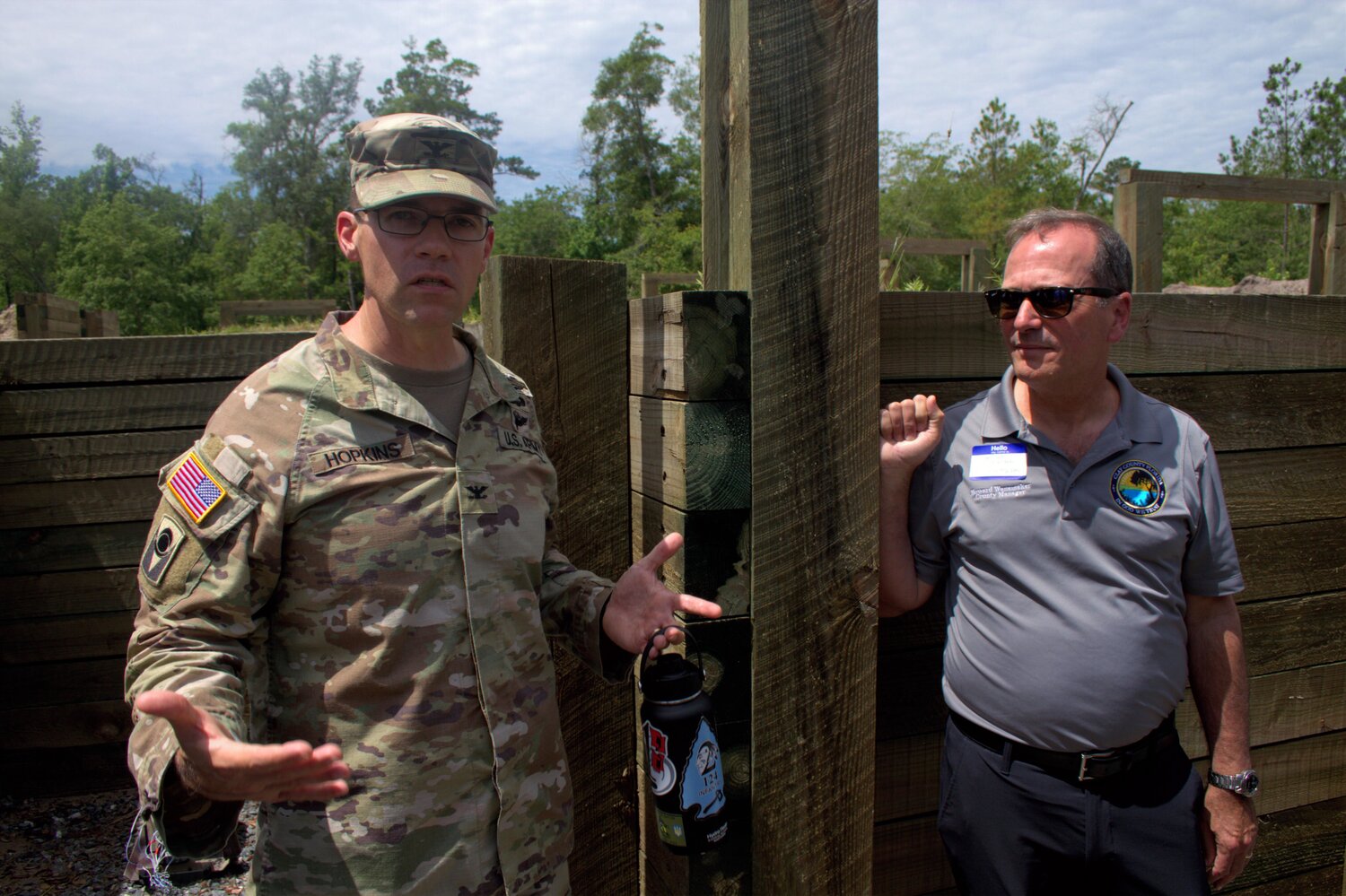
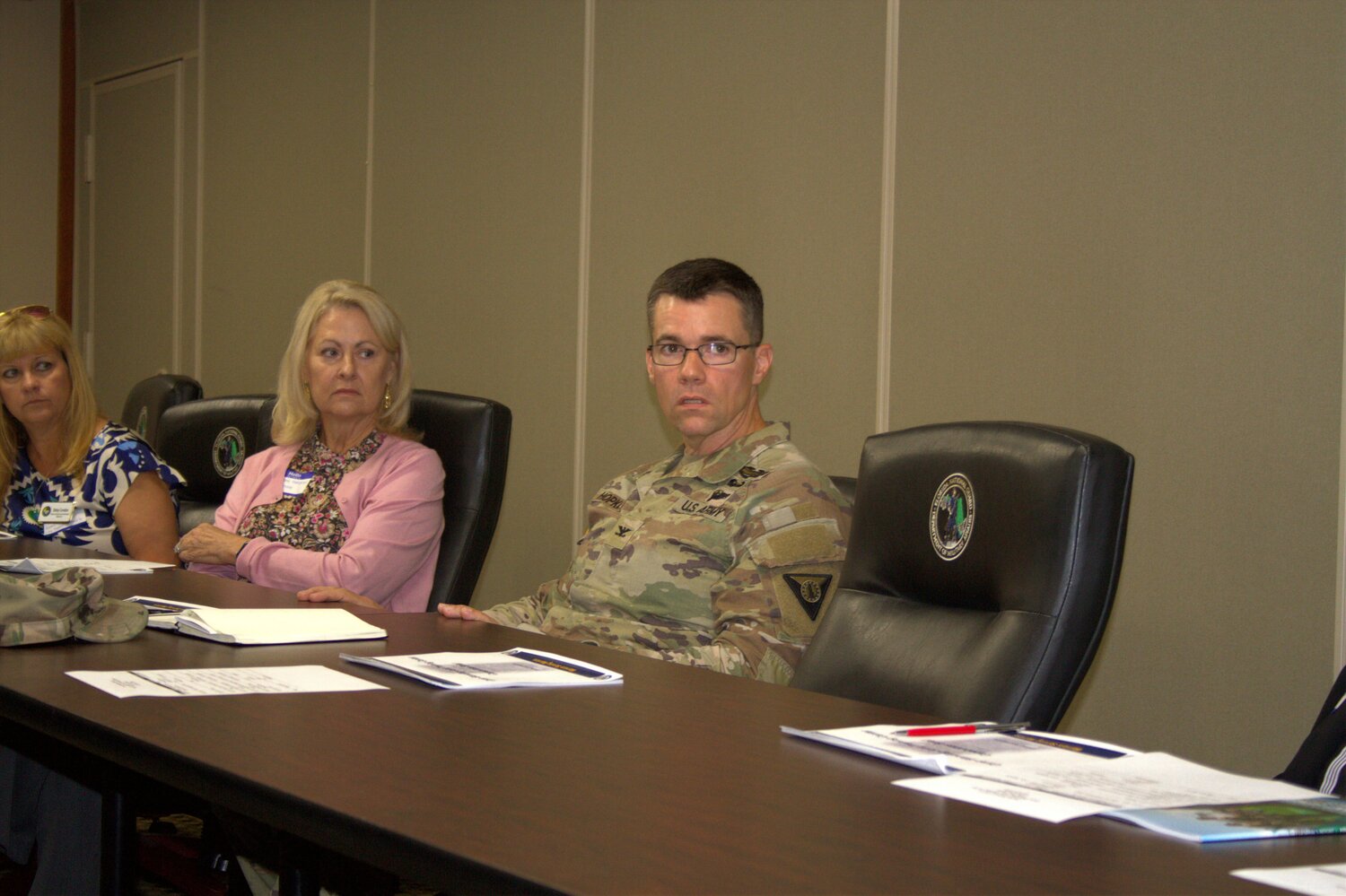



CAMP BLANDING – As the base commander of Camp Blanding Joint Training Center, Col. Todd Hopkins realized how few realized what knows what’s beyond the collection of military aircraft and miles of fencing and pine trees in the southwest corner of the county.
As he moved through a crowd of guests at the recent Military Appreciation Luncheon, Hopkins decided to open the curtains of the massive complex to municipal and county officials on Tuesday, June 2, in what will be known as “Clay Day,” and it proved to be more than a hidden secret. It was astonishing.
“I’m going to make sure that you not only hear about what we do, and I’ll talk about that here, we’ll drive around out to one of the ranges,” Hopkins said.
The first tour included Keystone Heights City Manager Jamie Booth, a retired U.S. Army colonel, Penney Farms CEO Teresa Scott, Clay Economic Development Corporation President Crawford Powell, Military Appreciation Luncheon organizer Attorney David King, Clay County Clerk of Court Tara Green, Clay County Commissioner Betsy Condon, Clay County Tax Collector Diane Hutchins, Clay County Assistant County Managers Karen Smith and Chereese Stewart, retired U.S. Navy Capt, former NAS Jacksonville base Commander and Clay County Manager Howard Wanamaker and District Aide for Florida Rep. Judson Sapp, Samantha Wernet.
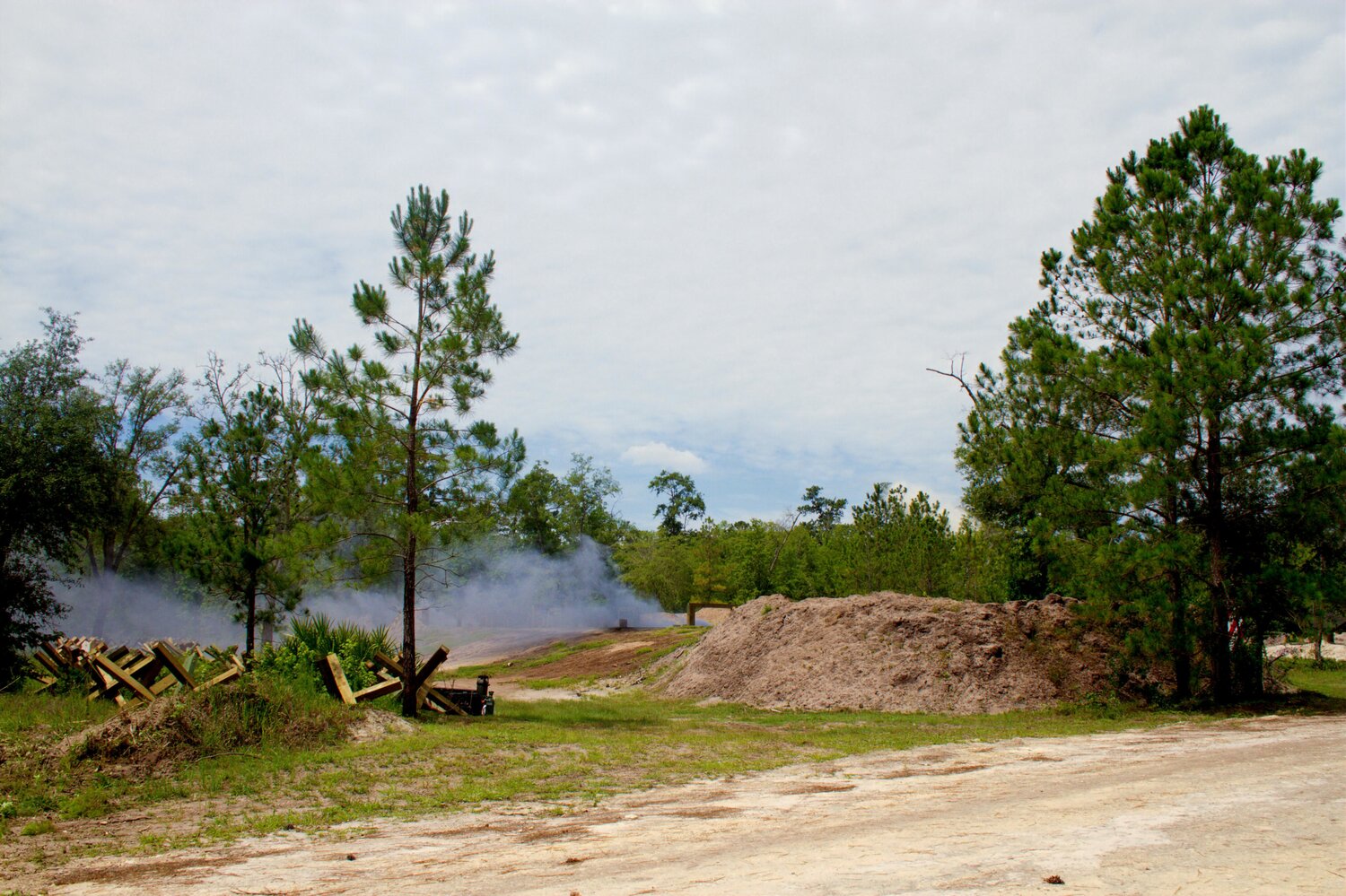
The drive took more than 20 minutes. And once the bus arrived, the group was greeted by machinegun fire, artillery fire and smoke, miles from the public’s eye.
Camp Blanding is that big.
The installation is 73,000 acres, and that equates to 114.1-square miles, or 20% the size of Clay County. It provides a world-class training area and mobilization support that generates and projects combat-ready forces to support Florida and the nation.
“The Florida National Guard has Camp Landing as its primary training installation,” Hopkins said. “Camp Blanding has been designated by both the National Guard Bureau by both the National Guard Bureau as well as the Department of War as a Level 1 training area, and a contingency mobilization force generation installation. So, two large acronyms, but Level 1 training center, means that we have the capacity to train brigade-sized maneuver elements here, and then some other minutia with respect to range capabilities for live fires, for platoons and companies, as well as stabilized gunnery for weapon systems mounted on vehicles.”
Camp Blanding has 55,000 acres for combat and non-combat arms, civilian law enforcement training, civic organizations, small-arms-to-high mobility artillery rocket launcher system, airborne operations, waterborne operations, seven areas of quarters with 4,403 bed spaces, 17 automated ranges supporting .50 caliber or less ammunition, 48 non-automated paper qualification and familiarization ranges, eight hard target ranges supporting anti-tank-4 shoulder fired weapon, light anti-tank weapon, 40mm grenade launcher, BGM-71 TOW tube-launched missiles, 26 mortar firing points, 60mm, 81mm and 120mm mortar low and high-angle fire, four observation points, 62 parachute landing zones, 32,000-foot ceiling (“We control the airspace,” Hopkins, said), aerial gunnery space, support multiple aircraft to include UAS (drones), drop zones static and high altitude, low opening operations drop zones, 330-acre Weinberg drop zone, co-located with military operations in urban terrain site, Lowery and Kingsley lakes (waterborne drop zones), 37 artillery firing points and 105mm and 155mm direct and high-angle fire artillery fire rocket system non-high explosives.
The camp has intergovernmental agreements with State Emergency Response Team from FloridaDisaster.org, Florida Department of Emergency Management, Florida Department of Law Enforcement, Florida Forest Service and the Florida Department of Corrections. It also has interagency agreements with the Federal Bureau of Investigation, Smithsonian Tropical Research Institute, the U.S. Department of Agriculture and FEMA.
Guyana, Grenada, St. Lucia, Barbados, St. Kitts, St. Vincent, Dominica, Antigua and Greece send its soldiers to Camp Blanding for training, and Venezuela will soon start sending its soldiers to the camp, Hopkins said.
The camp hires 300 employees and is open about 179 days a year, although it was operational nearly 280 days last year. During its peak months between June-through-August, it averages 10,000 soldiers, and about 100,000 trains there every year. To keep up with the demand, construction is ongoing.
“Camp Blanding has seen more construction projects now than it’s seen in the past 20 years,” Hopkins said.
There currently are 38 projects under construction, Hopkins said.
With such a large area, and most of it consisting of thick underbrush, pine trees and dry foliage, the camp has an aggressive burn schedule to reduce the chance of an accidental forest fire.
“We have the most active burn program in the nation,” he said.
The secluded area is home to six federal and nine state listed and regulated supported wildlife species – the red cockaded woodpecker, Eastern Indigo snake, gopher tortoise, tri-colored bat, Florida pine snake, striped newt and Black Creek crayfish.
When the group arrived at the Infantry Platoon Battle Course of the Multipurpose Training Range, they were greeted by a barrage of simulated machine gun, RPG and sniper fire, mortar blasts and thick wafts of black smoke to create the confusion and challenges of the battlefield.
For a soldier in training, it’s a day at the office, another step to ensure the United States remains free for another 250 years, Hopkins said.
The onlookers seemed overwhelmed by the complexity and the immensity of the presentation. Clay Day was more than a show of smoke and thunder. It was an eye-opening reminder that Camp Blanding may be quietly in the southwest corner of the county, but it leaves a significant boot print.
